Cage Mill Machine
Description
What Is a Cage Mill Machine?
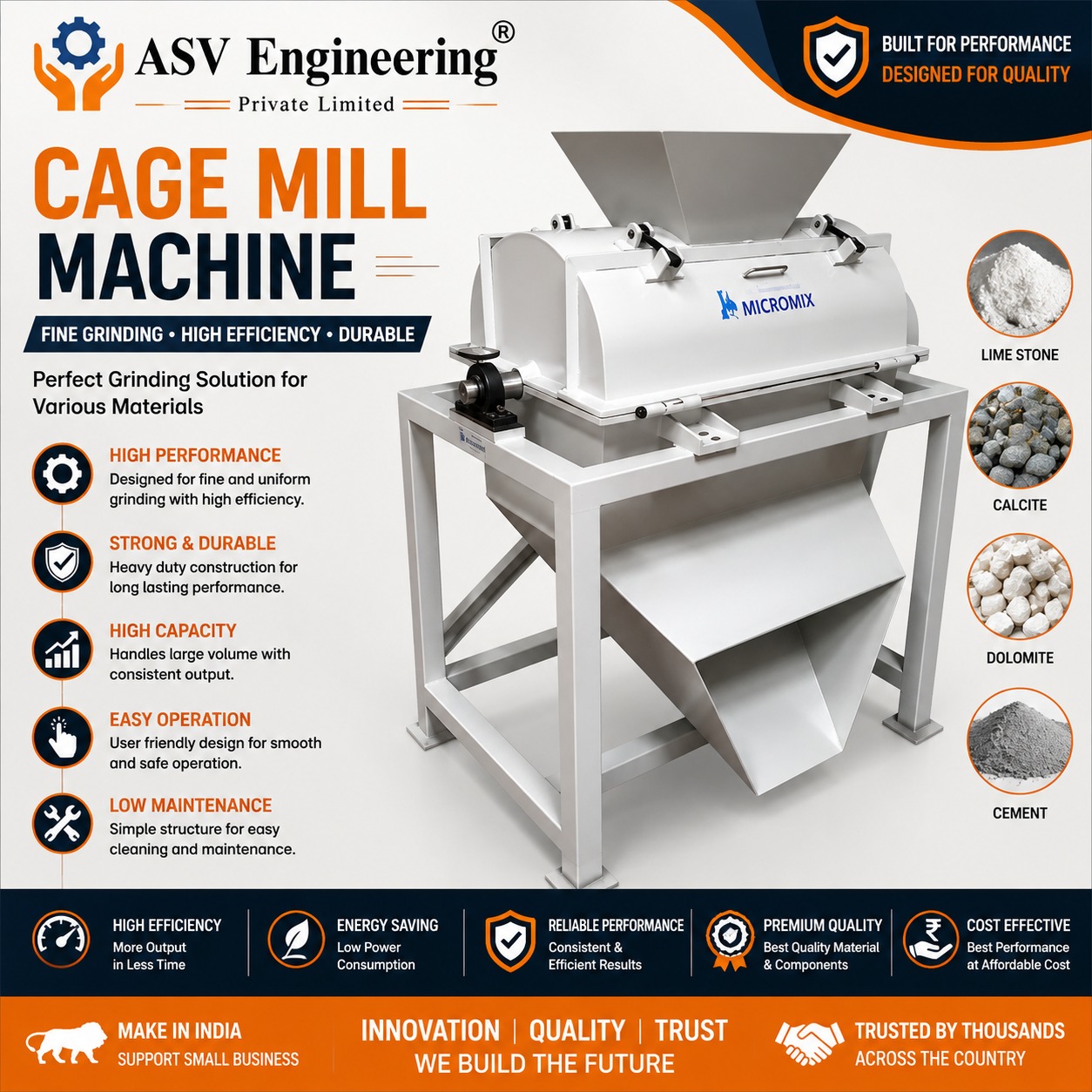
A cage mill is a type of impact crusher that uses one or more高速 rotating cages to break down lumped or agglomerated materials into smaller, more uniform particles through repeated impact and collision. As a knowledgeable cage mill machine manufacturer and supplier in Delhi, India, we produce these machines for mineral processing, chemical manufacturing, fertiliser plants, salt refining, and construction material industries. Unlike jaw crushers or cone crushers that rely on compression, the cage mill uses impact force, which makes it particularly effective on friable and medium-hard materials that shatter easily under sudden impact. The result is a more controlled particle size distribution with fewer oversized lumps and less excessive fines.
How Does a Cage Mill Break Down Material?
The machine houses one or more concentric cages, each consisting of a central rotor with outward-projecting bars or pins arranged in a circular pattern. The cages rotate at high speed, typically between 800 and 2000 RPM, in alternating directions when multiple cages are used. Material fed into the mill centre is thrown outward by centrifugal force and encounters the rapidly spinning cage bars. The impact shatters the material against the bars and against the cage shell. When two concentric cages rotate in opposite directions, the material is struck from both directions simultaneously, significantly increasing the breakage efficiency. The broken material exits through adjustable discharge openings at the bottom of the machine. Gap settings between cages control the final product size, and adjusting these gaps lets operators tune the output gradation without changing internal components.
Key Features of Our Delhi-Fabricated Cage Mills
Our cage mills use hardened alloy steel cage bars or manganese steel liners depending on the abrasiveness of the material being processed. The rotor assemblies are dynamically balanced for smooth, vibration-free operation at high speeds. Bearing housings use heavy-duty spherical roller bearings mounted in split housings for easy inspection and replacement. The frame is constructed from welded heavy-section steel with reinforced critical stress points. Adjustable cage bar gaps allow operators to control product fineness without shutting down the machine. Feed hoppers with controlled feed rates prevent overloading and ensure consistent product quality. Access doors on the machine body allow quick inspection and liner replacement without major disassembly.
Technical Specifications
Motor power ranges from 7.5 HP for laboratory and pilot-plant models to 50 HP for high-capacity industrial units. Rotor speed is adjustable between 800 and 2000 RPM. Number of cages available are single, double, and triple configurations. Feed size acceptance ranges up to 100 mm for the standard model and up to 200 mm for the heavy-duty variant. Product size output is adjustable from 2 mm to 25 mm by changing cage gaps. Throughput capacity spans from 500 kg per hour on the smallest model to 10 tonnes per hour on the largest industrial machine. Weight ranges from 600 kg to 4000 kg. Operating voltage is 415V three-phase, 50 Hz.
Applications and Industries Served
Cage mills are widely used in the fertiliser industry to break down compacted ammonium sulphate, DAP, and NPK granules back to the desired size range. Salt refining operations use cage mills to break lumped salt crystals after drying. The limestone and calcium carbonate processing industry uses cage mills for secondary crushing after primary jaw crushing.化工 manufacturers break down agglomerated chemicals, pigments, and resin compounds. The construction materials sector uses cage mills to produce manufactured sand from limestone and dolomite. Gypsum processing for plaster and cement retarder applications also employs cage mills. The mining industry uses them for soft to medium-hard ore reduction.
Benefits of Choosing a Cage Mill Over Other Crushers
The cage mill offers several distinct advantages over compression-type crushers. The impact breakage mechanism produces a more cubical particle shape compared to the elongated or flaky particles that jaw crushers often generate. This cubical shape is preferred in construction aggregates and manufactured sand applications. The adjustable gap control provides precise product size regulation without changing dies or concaves. Cage mills handle slightly moist or sticky materials better than many crusher types because the centrifugal action prevents material from clinging to the crushing surfaces. Maintenance is straightforward because the primary wear parts are the cage bars and liners, which are accessible through the side doors. Energy consumption per tonne of product is competitive with other crusher types for medium-hard materials.
Maintenance and Care Instructions
Inspect cage bars and liners every 200 operating hours and replace any that show significant wear or cracking. Worn bars reduce impact efficiency and increase the proportion of oversize material in the product. Check bearing temperature at each shift start using a contact thermometer and investigate any reading above 70 degrees Celsius immediately. Lubricate bearings every 150 operating hours with the manufacturer-recommended grease. Inspect drive belts weekly for proper tension and wear. Check feed hopper and discharge chute alignment monthly to prevent material spillage. Tighten all structural bolts quarterly to counteract vibration-induced loosening. Maintain a stock of spare cage bars and liner plates to minimise downtime during scheduled replacements.
Frequently Asked Questions
What is the price of a cage mill machine?
Pricing depends on machine size, motor power, number of cages, and liner material selection. Contact our Delhi factory at +91 8588856870 for a quotation specific to your material and capacity requirement.
What materials can a cage mill process?
Cage mills effectively process limestone, gypsum, salt, fertiliser compounds, calcium carbonate, dolomite, soft ores, chemicals, and many other friable materials. Hard or highly abrasive materials may require specialised liner materials.
How do I adjust the product size?
Product size is controlled by adjusting the gap between the cage bars and the cage shell or between concentric cages. Larger gaps produce coarser product. The adjustment is done through external bolts without disassembling the machine.
Can the cage mill handle wet material?
Moderate moisture content is acceptable. However, very wet or sticky material may cause buildup on the cage bars and reduce efficiency. For consistently wet materials, we recommend discussing modified configurations with our team.
Why Choose Our Delhi Factory and How to Order
We design and manufacture cage mills at our Nangloi Delhi factory for clients across the Indian industrial landscape. Our engineering team has experience with fertiliser plants, mineral processing facilities, and chemical manufacturing units, allowing us to recommend the right cage mill configuration for your specific material and throughput target. We have installed machines in multiple Indian states and maintain a network of service contacts for ongoing support. To discuss your crushing requirement, get a quotation, or visit our factory to see a machine in operation, call us at +91 8588856870. We provide pan-India delivery with installation and commissioning at your site.
| Specification | Details |
|---|---|
| Machine Type | Cage Mill Machine |
| Body Material | SS304 / MS |
| Power Supply | 220V/440V Three Phase |
| Warranty | 1 Year |
Related Products
Screening Machine
View Details
Centrifugal Chalna Separator
View Details
Malli Machine
View Details