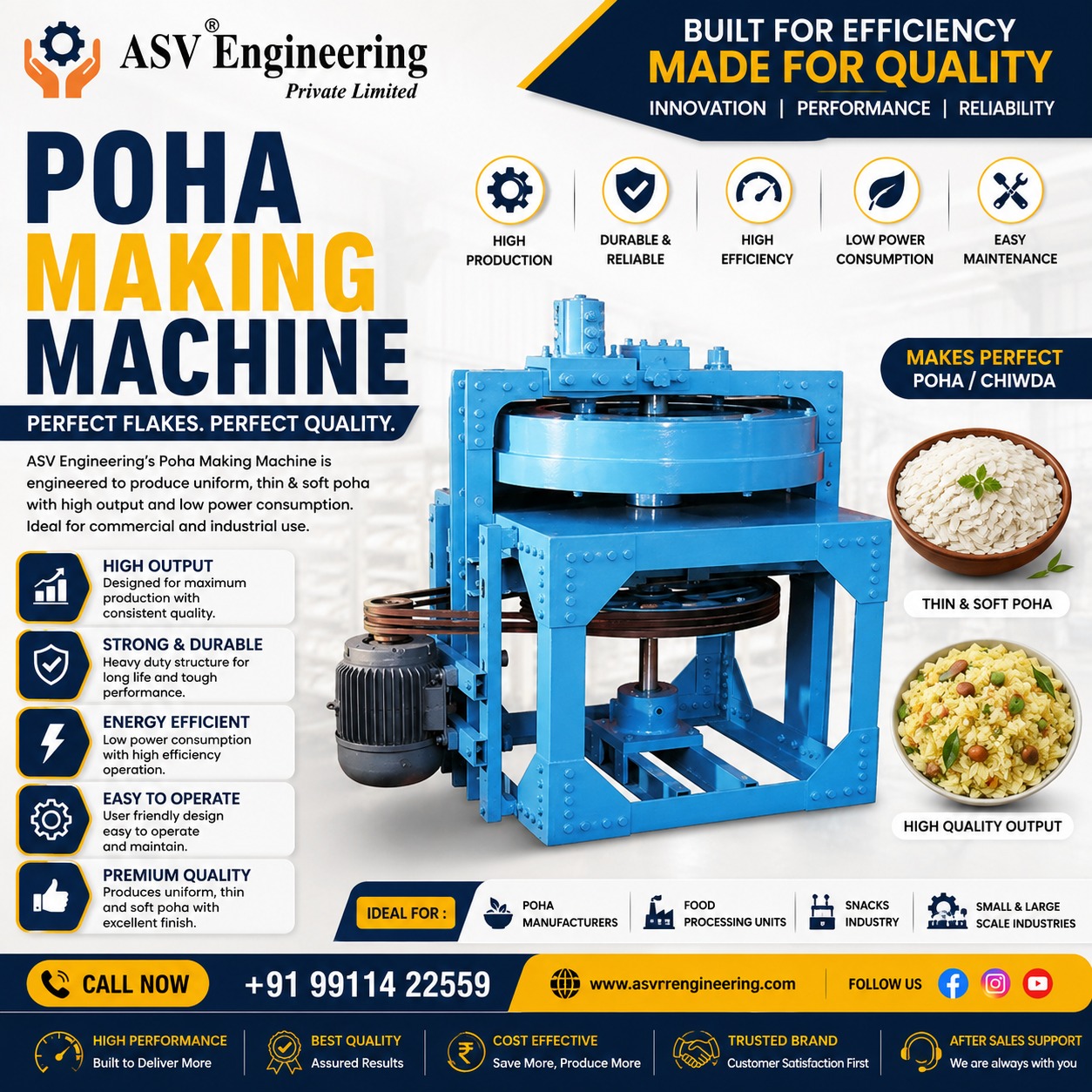
Poha Making Machine
Description
Poha Making Machine – Reliable Manufacturer & Supplier in Delhi, India
Poha is one of India's most beloved breakfast foods, eaten daily by millions of people from Mumbai to Kolkata and everywhere in between. The production of quality poha requires precision processing that transforms raw rice into perfectly flattened flakes, and that is exactly what our poha making machine accomplishes with impressive efficiency. As a specialized poha making machine manufacturer in Delhi, India, we build equipment that handles every stage of the poha production process from rice parboiling and drying to flattening and grading, delivering consistent quality that meets market expectations.
The poha industry in India operates on thin margins where efficiency and quality directly determine profitability. Our machines are designed with this reality in mind, focusing on maximum output with minimum waste, energy-efficient operation, and minimal labor requirements. We have supplied poha making machines to producers across Maharashtra, Madhya Pradesh, Gujarat, Uttar Pradesh, and other major poha-consuming states, and our machines have proven their reliability in diverse operating conditions. Whether you are a small-scale rural producer or a large commercial processor, we have a poha making machine configuration that fits your needs and budget.
Key Features of Our Poha Making Machine
The machine integrates multiple processing stages into a streamlined workflow. The parboiling section heats and soaks the rice to soften the grain appropriately before flattening. The drying section uses controlled hot air to reduce moisture content to the precise level needed for effective flattening. The flattening section employs heavy-duty rollers that press the prepared rice into thin, uniform flakes. The grading section separates the flattened poha into different sizes and removes broken pieces, giving you a consistent, market-ready product.
Temperature and moisture controls at each stage can be adjusted to produce different grades of poha, from thick varieties preferred in some regions to thin, paper-like poha popular in others. The machine operates continuously, meaning raw rice goes in one end and finished poha comes out the other without interruption. This continuous processing approach maximizes throughput and minimizes the handling that can damage fragile flattened rice.
How Does a Poha Making Machine Work
The process begins with raw rice, which is first cleaned and soaked in the parboiling unit at a controlled temperature for a specific duration. This parboiling step partially cooks the rice grain and makes it pliable enough to flatten without breaking into powder. After parboiling, the rice is spread onto a drying conveyor where warm air reduces the moisture content to around twelve to fifteen percent. This moisture level is critical, too much moisture and the grain will mash instead of flatten, too little and it will shatter.
The partially dried rice then enters the flattening section where it passes through a pair of precisely spaced steel rollers. The pressure from the rollers compresses each grain into a flat flake. The roller gap determines the thickness of the final poha, and this can be adjusted for different product specifications. After flattening, the poha moves through a grading system that separates whole flakes from broken pieces and dust, and the finished product is collected for packaging.
Technical Specifications
Our poha making machine range spans from small-scale manual-assist models to fully automatic industrial units. The small model processes one hundred kg of raw rice per hour and requires two to three operators. The medium model handles three hundred kg per hour with minimal manual intervention. The large industrial model processes up to one thousand kg per hour and integrates seamlessly with automated rice feeding and poha packaging systems.
All models feature robust mild steel frames with food-grade stainless steel processing components. The parboiling tank capacity varies from 100 liters in the small model to 500 liters in the industrial model. The flattening rollers are made from hardened steel for long operational life. Power requirements range from 10 HP for the small model to 40 HP for the industrial unit, operating on three-phase power supply. The entire machine assembly weighs between 800 kg and 3000 kg depending on the model. Floor space requirements range from 200 square feet for the compact unit to over 1000 square feet for the full industrial setup.
Applications and Industries Served
Our poha making machines serve a wide spectrum of businesses in the Indian food processing industry. Small and medium rice millers use our machines to add value to their rice production, converting raw rice into finished poha that commands higher market prices. Large poha manufacturers deploy our industrial models for high-volume production that supplies supermarkets, grocery chains, and institutional buyers. Co-operative societies and self-help groups in rice-producing regions use our compact models to establish local poha production businesses.
The machine is also valuable for producers who want to offer different poha varieties. With adjustable settings, the same machine can produce thick poha, thin poha, nylon poha, and other regional variations, allowing producers to serve multiple market segments from a single equipment investment. Export-oriented producers use our machines to meet the quality and consistency standards required for international markets.
Benefits of Our Poha Making Machine
The primary benefit is the transformation of a low-value commodity, raw rice, into a higher-value finished product, poha, that earns better market returns. Our machines are built for durability and can operate for years with proper maintenance, providing consistent returns on your investment. The automation they bring reduces dependence on skilled manual labor, which is increasingly difficult to find and expensive to retain in the food processing industry.
Energy efficiency is another significant advantage. Our machines are designed to minimize power consumption per kilogram of poha produced, using efficient motors and optimized heating systems. The continuous processing design means there is minimal idle time, keeping energy costs low. Waste reduction is built into every stage of the process, from the parboiling system that prevents grain damage to the grading system that separates and can redirect broken pieces for alternative uses.
Maintenance and Care
Daily cleaning of the poha making machine involves removing residual rice and poha from all processing surfaces, wiping down the parboiling tank, and ensuring the drying section is free of dust buildup. Weekly maintenance includes checking roller alignment and spacing, inspecting conveyor belts for wear, and lubricating bearings and drive mechanisms with food-grade lubricant. Monthly tasks include checking electrical connections, testing temperature sensors for accuracy, and inspecting the grading screens for damage. A comprehensive annual service is recommended for all machines, and we offer maintenance contracts that include regular inspections and preventive servicing. Keeping a detailed maintenance log helps track the machine condition and plan for component replacements before they cause production disruptions.
Frequently Asked Questions
**What is the price of a poha making machine?**
Our poha making machines are priced competitively starting from approximately three lakh rupees for the small model up to twelve lakhs or more for the fully automatic industrial setup. Contact us for detailed pricing based on your specific requirements.
**How much poha can the machine produce in a day?**
This depends on the model and operating hours. The small model produces roughly 800 to 1000 kg in an eight-hour shift. The medium model produces 2000 to 2500 kg, and the large industrial model can produce 6000 to 8000 kg per shift.
**Can the machine produce different thickness of poha?**
Yes, the roller gap in the flattening section is adjustable, allowing you to produce thin, medium, or thick poha depending on market demand and regional preferences.
**What raw materials are needed?**
The primary raw material is raw rice, preferably parboiled rice varieties that respond well to the flattening process. Water is needed for the parboiling stage, and a clean energy source, either electricity or fuel, for heating and drying operations.
Why Choose Our Delhi Factory and How to Order
As a poha making machine manufacturer based in Delhi with our production facility in Nangloi, we offer the advantage of direct access to engineering expertise and after-sales support. Our machines are designed specifically for Indian rice varieties and Indian market requirements, and we back every sale with responsive service support. We understand that downtime in food production means lost revenue, so we maintain ready stock of critical spare parts and offer rapid-response service calls.
Pan-India delivery is available with professional installation and operator training included. We have successfully installed poha making machines across the length and breadth of India, and our installation team is experienced in working in diverse environments from urban factories to rural processing centers. To discuss your requirements or to arrange a factory visit, call us at +91 8588856870. Our Nangloi factory welcomes visitors who want to see our poha making machines in operation before making their purchase decision. We are here to help you build a profitable poha production business with the right equipment.
| Specification | Details |
|---|---|
| Machine Type | Poha Making Machine |
| Body Material | SS304 / MS |
| Power Supply | 220V/440V Three Phase |
| Warranty | 1 Year |
Related Products
Pulverizer Machine
View Details
Chapati Making Machine
View Details
Atta Chakki Machine
View Details