Paneer Press Machine
Description
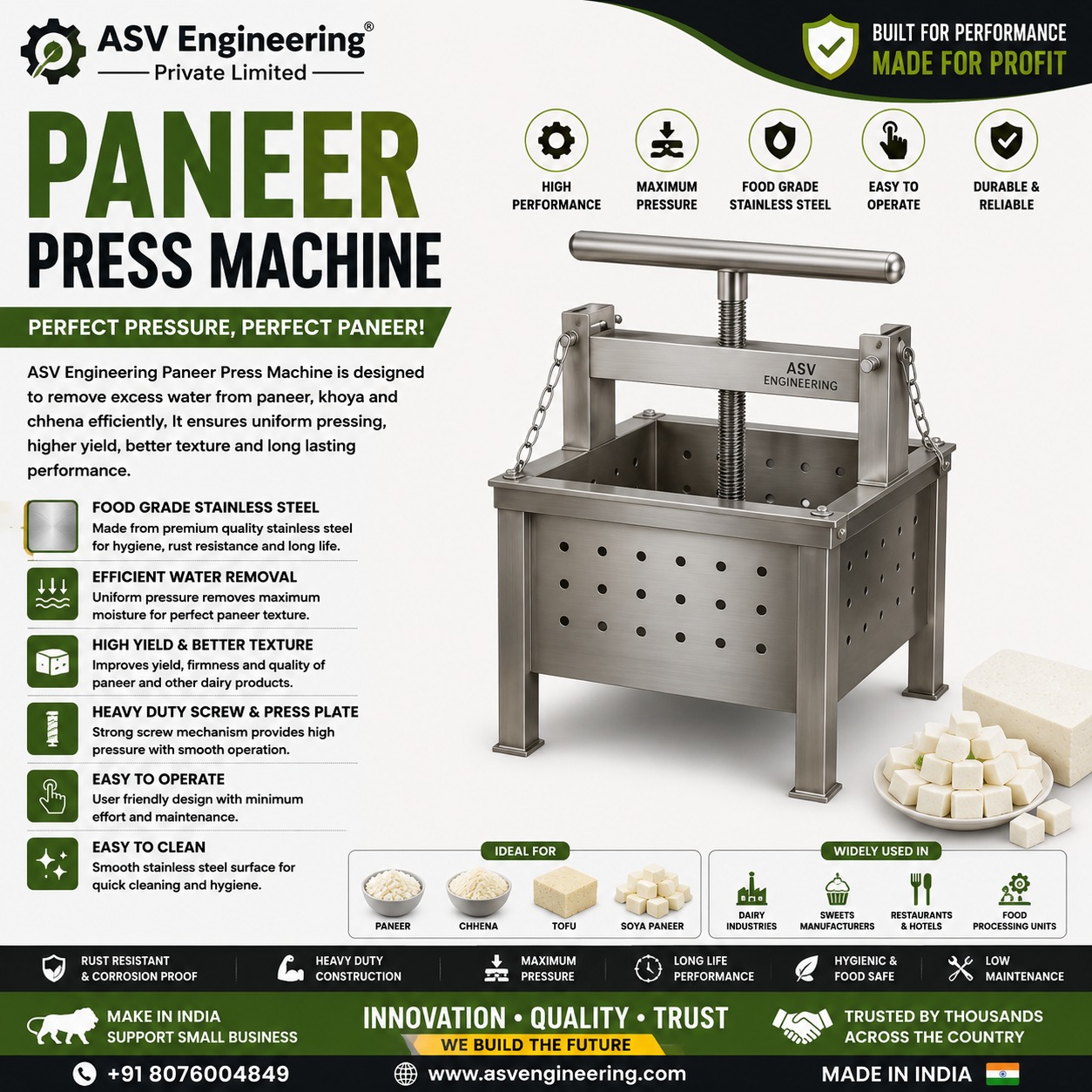
Need a dependable paneer press machine manufacturer and supplier in Delhi, India? Our manually operated paneer press machine offers a cost-effective, robust solution for dairy businesses that want better pressing consistency than hand-pressing without the higher investment of a fully automatic system. It is the ideal choice for dairy shops, sweet shops, small paneer producers, and food entrepreneurs who are scaling up from weight-based pressing to a proper mechanical press. Manufactured at our Nangloi, Delhi factory, this machine uses high-quality steel and food-grade components to deliver years of reliable service.
What is a paneer press machine? A paneer press machine is a mechanical device that applies steady, adjustable pressure on fresh paneer curd placed inside a mould, forcing out whey and compacting the curd into a neat, solid block. In a manual model, the operator turns a screw handle or lever to lower the pressing plate onto the curd. This gives much more control and consistency than the traditional method of placing a heavy stone or water-filled container on top of the curd, which applies uneven pressure and often produces blocks with soft spots, uneven edges, and inconsistent weights.
Key Features and Build Quality. The frame is constructed from thick mild steel channels welded into a rigid structure that will not flex or warp under load. The pressing plate and mould tray are made from AISI 304 food-grade stainless steel, ensuring that nothing that touches the paneer is made from a material that could rust, stain, or contaminate the product. The screw mechanism uses a large-diameter acme thread that turns smoothly even when applying high pressure, and a Teflon bushing prevents metal-to-metal contact so the handle operates without needing frequent lubrication. The mould tray has drainage holes on the bottom and a matching whey collection tray beneath it that slides out for easy emptying. You can purchase additional mould trays in different sizes to produce everything from small 200-gram retail blocks to large 2-kilogram blocks for commercial buyers. The machine stands on four rubber feet that grip the work surface and prevent sliding during operation.
How does the paneer press machine work? After the milk has been coagulated using lemon juice, vinegar, or citric acid, and the curds have been gathered in a muslin cloth, you place the cloth-wrapped curds into the stainless steel mould tray. Set the mould tray onto the base of the press. Turn the handle clockwise to lower the pressing plate onto the curd. As the plate makes contact and you continue turning, pressure builds steadily and whey begins to squeeze out through the drainage holes. You can feel the resistance increase as the curd compacts, and experienced operators learn to gauge the right amount of pressure by feel. Most producers press for 15 to 30 minutes for a medium-firm block, though the exact time depends on how firm you want the final paneer. When the pressing is done, you turn the handle counterclockwise to raise the pressing plate, remove the mould, and transfer the paneer block to cold water to set and firm up further.
Technical Specifications. The screw press has a pressing diameter of 300 mm, which comfortably fits our standard mould trays. Maximum pressing force is approximately 50 kilograms applied at the handle, which translates to a significant compressive force on the curd surface thanks to the mechanical advantage of the screw. The overall machine height is about 700 mm, width 400 mm, and depth 350 mm. Weight is approximately 28 kilograms, making it portable enough for two people to move. The mould tray volume accommodates roughly 5 to 6 litres of curd for a standard block. Power is not required because this is a fully manual machine, making it suitable for locations with unreliable electricity or for producers who prefer zero energy costs on this stage of production. The base plate is detachable for thorough cleaning.
Applications and Industries. This paneer press machine is widely used by dairy shops that make fresh paneer every morning, sweet shops that need paneer for rasgulla, chamcham, and other sweets, small-scale paneer manufacturers who sell to local retailers and restaurants, household-based paneer entrepreneurs who operate from home under FSSAI registration, and milk cooperatives at the village level where paneer is a value-added product made from surplus milk. Hotels and restaurants with in-house paneer requirements also find this manual press to be a practical investment.
Benefits of Choosing Our Manual Paneer Press. The primary benefit is affordability. You get a well-built, food-safe pressing machine at a fraction of the cost of an automatic system, which makes it accessible even for someone just starting a paneer business. Despite being manual, it produces far more consistent results than weight-based pressing because the screw applies centred, even pressure across the entire surface of the curd. The result is paneer blocks that are uniform in density, cut cleanly, and have a professional appearance that customers notice. There are no electrical parts to fail and no pneumatic components to maintain, so the machine is virtually maintenance-free aside from occasional cleaning. It is also quiet in operation, which is a plus in shop environments where noise is a concern.
Maintenance and Care. After each use, disassemble the mould tray and collection tray and wash them thoroughly with warm soapy water. Wipe the screw mechanism with a damp cloth and dry it completely to prevent any surface rust on the mild steel frame. Once a month, apply a small amount of food-safe grease to the screw threads to keep the handle turning smoothly. Inspect the rubber feet periodically and replace them if they become worn to maintain stability. Store the machine in a dry location and cover it with a clean cloth when not in use to keep dust and insects away from the food-contact areas.
Frequently Asked Questions. How much does a manual paneer press machine cost? Our manual paneer press is one of the most affordable options in the market. Contact us for current pricing and any ongoing offers. Can I make tofu with this machine? Yes, the same pressing mechanism works for pressing tofu curds into blocks. What size blocks can it make? Our standard mould produces blocks weighing approximately 500 grams to 1 kilogram. Additional mould sizes are available separately. Is this machine suitable for commercial use? Absolutely. Many commercial paneer producers use manual presses during peak hours alongside their automatic machines to increase total output.
Why Choose Our Delhi Factory and How to Order. We build our paneer press machines in-house at our Nangloi, Delhi factory using locally sourced materials and in-house quality checks at every stage of fabrication. Buying from us means you get a factory-direct price, personalised service, and access to spare parts and additional mould sizes whenever you need them. We deliver across India with safe packaging to ensure your machine arrives in perfect condition. To place an order, request a quote, or visit our factory to see the machine before you buy, call us at +91 8588856870. Delivery within Delhi NCR is typically within one week, and pan-India shipments take two to three weeks depending on your location.
| Specification | Details |
|---|---|
| Machine Type | Paneer Press Machine |
| Body Material | SS304 / MS |
| Power Supply | 220V/440V Three Phase |
| Warranty | 1 Year |
Related Products
Pulverizer Machine
View Details
Chapati Making Machine
View Details
Atta Chakki Machine
View Details