Khoya Making Machine
Description
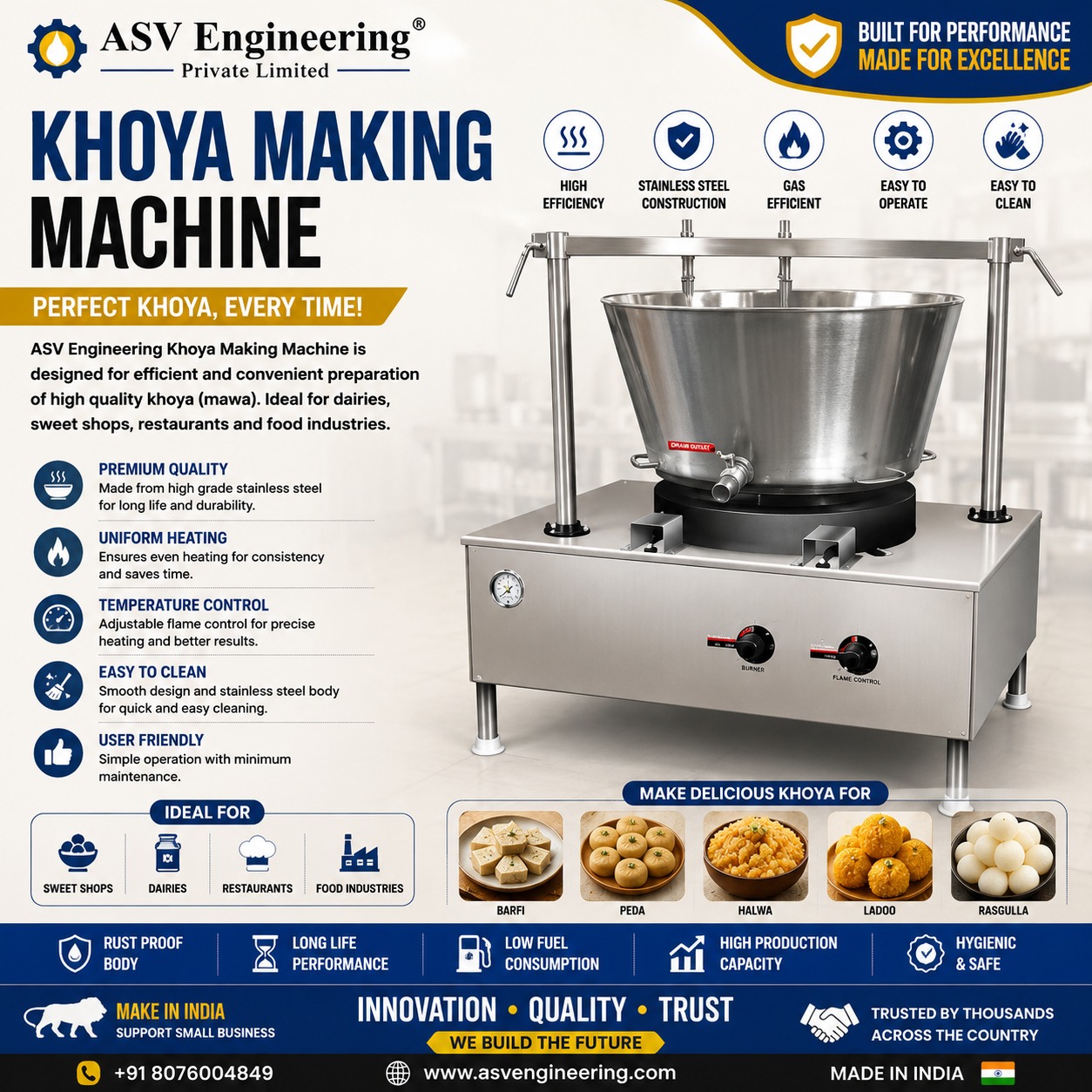
Searching for a trusted khoya making machine manufacturer in Delhi, India? Our commercial khoya making machine is designed to produce rich, thick, perfectly cooked khoya, also known as mawa, from fresh milk in a fraction of the time and labor that traditional methods demand. Used by sweet shops, mithai manufacturers, dairy processing units, and cloud kitchens that prepare Indian desserts in bulk, this machine delivers consistent quality, prevents burning, and frees kitchen staff from hours of stirring over an open flame.
Introduction and Overview
Khoya is the concentrated milk solid that forms the base of countless Indian sweets including gulab jamun, peda, barfi, kalakand, and milk cake. Traditionally, making khoya involves simmering large quantities of milk in an open kadhai for three to four hours, stirring constantly to prevent the milk from scorching on the bottom. This process is labor-intensive, requires experienced personnel, and is prone to inconsistent results from batch to batch. Our khoya making machine eliminates these problems by automating the heating, stirring, and evaporation process inside a controlled, jacketed vessel. The result is uniformly cooked, high-quality khoya produced reliably every time. If you run a sweet shop, a mithai manufacturing unit, or a dairy processing business in Delhi or anywhere in India, this machine will transform your khoya production efficiency.
Key Features
The machine uses a steam-heated or electrically heated jacketed vessel with a motorized stirring arm that keeps the milk in constant, gentle motion throughout the concentration process. The vessel walls are constructed from thick-gauge food-grade stainless steel that distributes heat evenly, eliminating hot spots that cause burning. The stirring arm is designed with scrapers that continuously wipe the vessel walls, preventing milk solids from sticking and caramelizing prematurely. Temperature is controlled via a digital thermostat that maintains the vessel at the optimal evaporation temperature. A tilting mechanism or discharge valve allows the finished khoya to be poured out safely once it reaches the desired consistency. Vessel capacity ranges from 20 liters to 200 liters, catering to operations of different scales. The machine operates on either 3-phase electric power or can be configured for steam heating where a boiler is available. The entire milk-contact path uses SS316 grade stainless steel for superior corrosion resistance and hygiene.
How It Works
Fresh milk is poured into the vessel through the top opening or via a pump connection on larger models. The heating system is activated, and the temperature is set to the required evaporation point, typically between 80 and 95 degrees Celsius. The motorized stirrer begins rotating, keeping the milk in constant motion. As the milk heats, water evaporates through a vented lid, gradually concentrating the milk solids. The scrapers on the stirrer continuously prevent buildup on the vessel walls. Over two to four hours depending on vessel size and milk quantity, the volume reduces to approximately one-sixth of the original, transforming liquid milk into thick, grainy khoya. The operator monitors consistency and stops the process when the khoya reaches the desired texture. The vessel is then tilted or the discharge valve opened to transfer the khoya to containers for cooling.
Technical Specifications
Vessel Capacity: 20 liters to 200 liters (milk volume). Final Khoya Yield: Approximately 15 to 18 percent of input milk volume. Heating Method: Electric immersion heaters or steam jacket. Electric Models: 6 kW to 30 kW depending on capacity. Steam Models: Require 2 to 10 kg per square centimeter steam pressure. Stirrer Motor: 0.5 HP to 3 HP. Stirrer Speed: 20 to 40 RPM, variable. Vessel Material: SS316 stainless steel. Frame Material: SS304 stainless steel. Temperature Control: Digital thermostat with 1-degree resolution. Discharge: Tilting mechanism or bottom valve. Machine Weight: 80 kg to 600 kg depending on capacity. Dimensions: Compact models from 3x3x4 feet up to large 6x5x6 feet units.
Applications and Industries
This machine is used by Indian sweet shops and mithai shops that produce large daily quantities of khoya-based sweets, organized mithai brands that manufacture and package gulab jamun, peda, and barfi for retail distribution, dairy cooperatives and private dairy companies that produce khoya as a value-added product, cloud kitchens and central kitchens of restaurant chains that prepare mithai components in bulk, and caterers who produce sweets for weddings, festivals, and large events. The machine is especially valuable during peak festive seasons like Diwali, Holi, and Eid when khoya demand surges and sweet shops need to maximize production without proportionally increasing staff.
Benefits
The primary benefit is time savings. Traditional khoya making takes three to four hours of continuous stirring. This machine reduces that to two to three hours with minimal human intervention, freeing staff for other kitchen tasks. Quality consistency improves because the digital temperature control and mechanical stirring prevent the undercooking or burning that commonly affects hand-made khoya. Hygiene is enhanced because the enclosed vessel reduces contamination risk compared to open kadhai cooking. The machine also improves safety by eliminating the need for workers to stand over large open flames for extended periods. Energy efficiency is optimized through the jacketed heating design, which transfers heat more effectively than direct flame contact.
Maintenance and Care
Clean the vessel thoroughly after every use with warm water and a food-safe dairy cleaning solution. Pay special attention to the scrapers and stirring arm where milk solids can accumulate. Inspect the scraper blades for wear and replace them when they no longer make full contact with the vessel wall. Check the heating elements or steam connections monthly for scale buildup and descale as needed. Lubricate the stirrer shaft seal and tilting mechanism quarterly. Inspect electrical connections and the thermostat calibration annually. Keep the lid gasket in good condition to ensure proper venting. When not in use for extended periods, leave the vessel clean and dry to prevent any corrosion or odor retention.
Frequently Asked Questions
How much milk can this machine process in one batch? Capacities range from 20 liters to 200 liters of milk per batch. Choose the size based on your daily khoya requirement. A 100-liter model produces approximately 15 to 18 kg of khoya per batch.
What is the price of a khoya making machine in Delhi? Pricing varies with vessel capacity, heating method, and level of automation. Contact our Nangloi Delhi factory at +91 8588856870 for a detailed quotation based on your production volume.
Can this machine be used to make other milk-based products? Yes, the same vessel can be used for reducing milk for rabri, basundi, or condensed milk products. The temperature and stirring speed can be adjusted for different recipes.
How much electricity does the machine consume? Consumption depends on the vessel size and heater rating. A 100-liter electric model with a 15 kW heater draws approximately 15 units of electricity per hour of operation. Steam-heated models are more economical if a boiler is already available in your facility.
Why Choose Our Delhi Factory and How to Order
Our Delhi factory in Nangloi specializes in dairy processing equipment manufacturing, and our khoya making machines are built with a deep understanding of the practical challenges that sweet makers face. We use SS316 stainless steel for the vessel because it is the correct grade for prolonged milk contact, not a cost-cutting alternative. Every machine is pressure-tested and trial-run with milk before dispatch. We offer multiple capacity models, steam and electric heating options, and customization for specific production requirements. Pan-India delivery and installation are included, and our service team is available for follow-up support. To discuss your khoya production needs and receive a quote, call +91 8588856870 or visit our Nangloi factory to see the machines in action. We are committed to helping sweet makers across India produce better khoya more efficiently.
| Specification | Details |
|---|---|
| Machine Type | Khoya Making Machine |
| Body Material | SS304 / MS |
| Power Supply | 220V/440V Three Phase |
| Warranty | 1 Year |
Related Products
Pulverizer Machine
View Details
Chapati Making Machine
View Details
Atta Chakki Machine
View Details