Hydraulic Press Brick Making Machine
Description
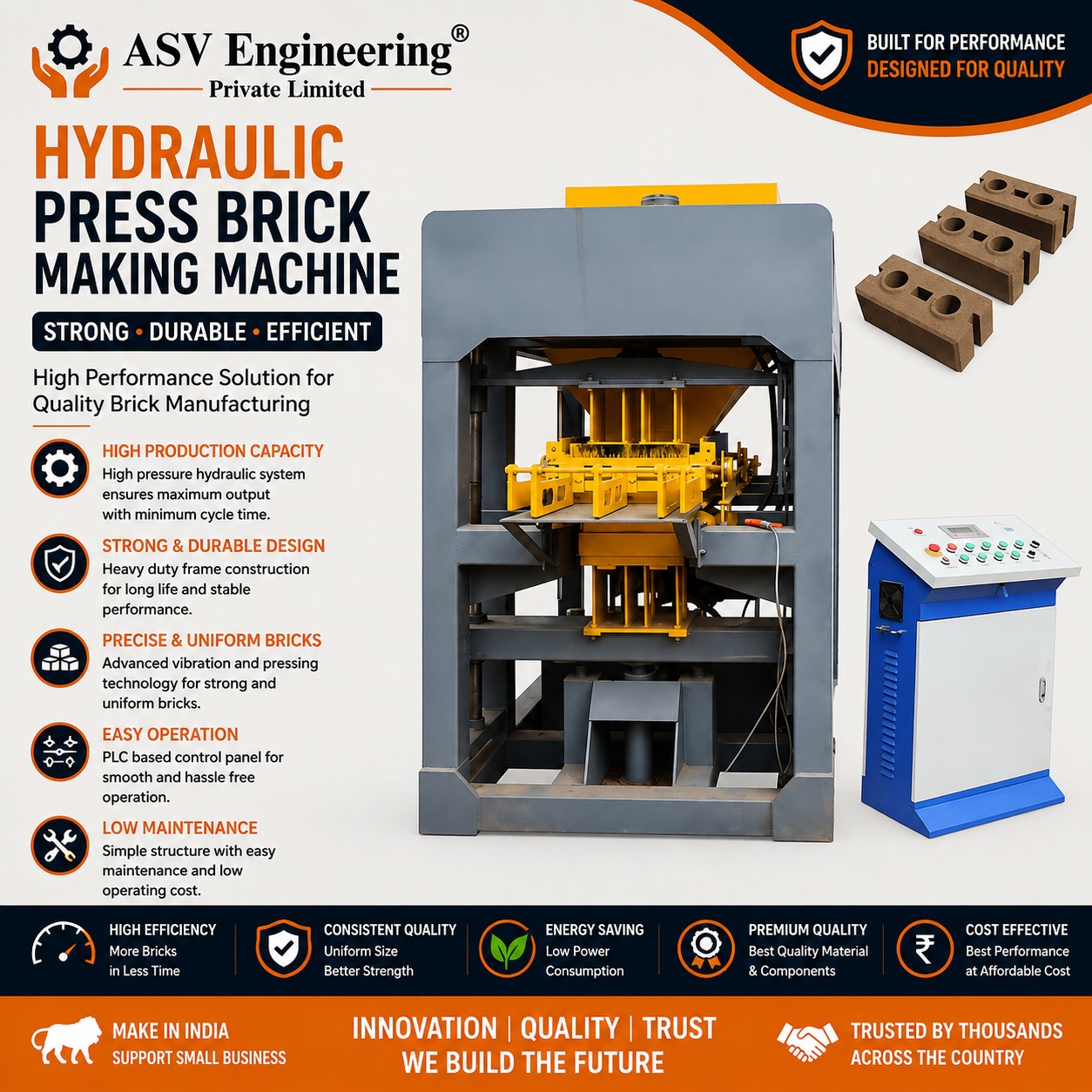
When infrastructure builders and construction material suppliers need a hydraulic press brick making machine manufacturer in Delhi, India, our factory provides heavy-duty equipment engineered to produce bricks, paver blocks, fly ash bricks, and concrete blocks with the strength, density, and dimensional accuracy that modern construction standards demand. A hydraulic press brick making machine uses immense hydraulic pressure rather than simple mechanical vibration to compact raw materials into solid, uniform blocks. This technology produces bricks with higher compressive strength, lower water absorption, and tighter dimensional tolerances compared to manual or vibration-only alternatives, making them suitable for structural applications where quality and durability are non-negotiable.
What Is a Hydraulic Press Brick Making Machine?
A hydraulic press brick making machine is an industrial device that compacts raw materials such as cement, fly ash, stone dust, quarry waste, red soil, and sand into bricks or blocks using hydraulic pressure. The machine forces a hydraulic ram downward onto a mould filled with the raw material mixture, applying hundreds of tonnes of pressure that compresses the loose material into a dense, solid block. Unlike manual brick moulding, which relies on hand tamping, or simple vibration tables that rely on gravity and shaking, hydraulic pressing achieves far higher compaction density, which directly translates to greater brick strength and durability. This type of machine is essential for manufacturers producing bricks for government construction projects, commercial buildings, housing developments, and infrastructure works where brick testing certifications are required.
Key Features
Our hydraulic press brick making machine is built around a robust welded steel frame designed to withstand the enormous forces generated during pressing without flexing or developing fatigue cracks. The hydraulic system uses a branded high-pressure pump, typically a gear pump or piston pump, that generates operating pressures between 100 and 200 bar. A precision-machined hydraulic cylinder drives the pressing ram with smooth, controlled motion that ensures even pressure distribution across the mould cavity. The mould assembly is fabricated from hardened tool steel that resists wear from abrasive raw materials like stone dust and fly ash. Interchangeable mould sets allow the same machine to produce different brick sizes and shapes, including standard bricks, fly ash bricks, interlocking pavers, and solid concrete blocks. A PLC or relay-based control panel manages the pressing cycle, including material feeding, pressing pressure, dwell time, and brick ejection. An integrated hydraulic oil cooling system prevents overheating during continuous production runs. Safety features include two-hand operation controls, protective guards around the pressing zone, and emergency stop buttons.
How Does the Hydraulic Press Brick Making Machine Work?
The operator loads the prepared raw material mixture into the mould cavity, either manually using a scoop or through an automated feeder box that slides across the mould and fills it evenly. Once the mould is filled and levelled, the operator initiates the pressing cycle. The hydraulic pump pressurizes oil in the system, which drives the cylinder and ram downward onto the material in the mould. The ram applies the programmed pressure, typically maintained for a dwell period of a few seconds to allow full compaction and air expulsion. After the dwell period, the ram retracts upward, and the mould bottom plate rises or the pressed brick is pushed out from the mould by an ejector pin. The finished brick is removed by hand or by an automated take-out system and placed on a pallet for curing. The mould then lowers back to the filling position, and the cycle repeats. A single cycle typically takes 15 to 30 seconds, and the machine can produce between 1000 and 5000 bricks per hour depending on the model, brick size, and whether the operation is manual or fully automated.
Technical Specifications
Hydraulic pressing force ranges from 20 tonnes to 200 tonnes depending on the machine model and brick type. The hydraulic system operates at pressures between 100 and 200 bar with a pump motor rated from 7.5 to 30 kilowatts, supplied on three-phase 415-volt connection. Mould sizes are customized to the required brick dimensions, with standard options including 230 mm x 110 mm x 75 mm for conventional bricks, 200 mm x 100 mm x 80 mm for fly ash bricks, and various paver dimensions such as 200 mm x 100 mm x 60 mm and 200 mm x 100 mm x 80 mm. Production capacity ranges from 1000 bricks per hour for manual-feed models to 5000 bricks per hour for fully automated lines with automatic material feeding and brick removal. The machine occupies a floor area of approximately 200 cm x 150 cm x 250 cm for mid-range models. Hydraulic oil tank capacity is 100 to 300 litres. Machine weight ranges from 1500 to 5000 kilograms depending on the pressing force and frame construction. Curing of pressed bricks requires 7 to 28 days of water curing or steam curing depending on the raw material mix and desired final strength.
Applications and Industries
Hydraulic press brick making machines serve the construction material manufacturing sector across India. Fly ash brick manufacturers who supply to government housing projects and infrastructure works use these machines to produce bricks that meet BIS specifications for compressive strength and water absorption. Concrete block makers who supply commercial construction projects produce solid blocks, hollow blocks, and paver blocks using the same machine with different mould sets. Red soil brick manufacturers in regions with abundant laterite soil use hydraulic pressing to produce high-density bricks for residential and commercial construction. Interlocking paver manufacturers supply landscaping, driveway, and pathway projects with precisely formed pavers that fit together without mortar. Stone dust brick manufacturers in quarry regions convert waste stone dust into valuable construction material. Government-funded housing schemes like PMAY frequently specify machine-made bricks, which creates strong demand for hydraulic press brick making machines in both urban and rural manufacturing settings.
Benefits of Hydraulic Press Technology
Compressive strength is the primary advantage. Hydraulic pressing achieves compaction densities that vibration-only machines cannot match, producing bricks with compressive strengths that consistently exceed minimum specifications. Dimensional accuracy improves because the hydraulic ram applies perfectly vertical, evenly distributed pressure, resulting in bricks with uniform thickness and sharp edges that stack neatly and require less mortar during construction. Surface finish is smoother and more consistent, which improves the appearance of exposed brickwork. Material efficiency increases because the high compaction density means less raw material is needed per brick to achieve the required strength. Water absorption is lower in hydraulically pressed bricks, which improves durability and resistance to weathering. Noise levels are significantly lower compared to vibration-based machines, which is an important consideration for manufacturing units located near residential areas. Production consistency is maintained throughout the day because hydraulic pressure is precise and repeatable, unlike manual tamping which varies with operator fatigue.
Maintenance and Care
The hydraulic press brick making machine requires systematic maintenance to preserve its pressing performance and extend equipment life. Daily tasks include checking the hydraulic oil level in the tank and topping up if necessary, inspecting the mould surfaces for material buildup and cleaning them, and checking all safety guards and emergency stops for proper function. Weekly maintenance involves inspecting hydraulic hoses and fittings for leaks or signs of wear, checking the ram guide and cylinder mounting bolts for tightness, and cleaning the hydraulic oil cooler fins to ensure adequate heat dissipation. Monthly tasks include testing hydraulic pressure against the gauge to verify the pump is delivering full force, inspecting the mould alignment and adjusting if brick dimensions drift from specification, and checking all electrical connections in the control panel. Hydraulic oil should be changed every 1000 to 2000 operating hours or annually, whichever comes first, and should be replaced with the manufacturer-recommended grade. Moulds should be inspected for wear monthly, and worn moulds should be refurbished or replaced to maintain brick dimensional accuracy. Our Delhi factory stocks replacement moulds, hydraulic cylinders, pumps, valves, hoses, seals, and control components for dispatch across India.
Frequently Asked Questions
What is the price of a hydraulic press brick making machine in India?
Pricing depends on the pressing force capacity, level of automation, and mould configurations included. Manual-feed machines with moderate pressing force start at a mid-range investment suitable for small-scale brick manufacturers. Fully automated high-pressure lines with multiple mould sets and automatic handling are priced for large industrial operations. Contact our sales team at +91 8588856870 for a detailed quotation based on your brick types, production targets, and automation preferences.
What raw materials can the machine use?
The machine processes a wide variety of raw materials including fly ash, cement, stone dust, quarry dust, red soil, sand, rice husk ash, and various industrial waste materials. The specific mix design depends on the brick type and the compressive strength required. We provide guidance on optimal mix designs for different raw material combinations.
How strong are hydraulically pressed bricks?
Hydraulically pressed bricks typically achieve compressive strengths between 7 and 15 Newton per square millimetre depending on the raw material mix and pressing force. Fly ash bricks commonly meet the IS 12894 standard requirements, and our machines can be configured to produce bricks that exceed these specifications for demanding structural applications.
Do you provide moulds for different brick sizes?
Yes. We supply mould sets for standard bricks, fly ash bricks, interlocking pavers, solid blocks, hollow blocks, and custom shapes. Moulds are manufactured from hardened tool steel for long service life, and additional mould sets can be ordered at any time as your product range expands.
Why Choose Our Delhi Factory and How to Order
Our Nangloi, Delhi factory is equipped with heavy fabrication facilities, hydraulic assembly workshops, and testing bays specifically for building brick making machines. We understand that a hydraulic press brick making machine is a major capital investment for our customers, and we build every unit to deliver reliable performance and long service life. Every machine is assembled, pressure-tested, and trial-produced before dispatch to verify pressing force, hydraulic system integrity, dimensional accuracy of output bricks, and safety system functionality. We offer pan-India delivery, on-site installation, operator training, and ongoing technical support. Our team can also advise on raw material sourcing, mix design optimization, and production planning for new brick manufacturing ventures. To discuss your brick production requirements, receive a customized quotation, or schedule a factory visit, call us at +91 8588856870. We are dedicated to helping Indian builders and manufacturers produce better bricks with dependable, high-quality equipment.
| Specification | Details |
|---|---|
| Machine Type | Hydraulic Press Brick Making Machine |
| Body Material | SS304 / MS |
| Power Supply | 220V/440V Three Phase |
| Warranty | 1 Year |
Related Products
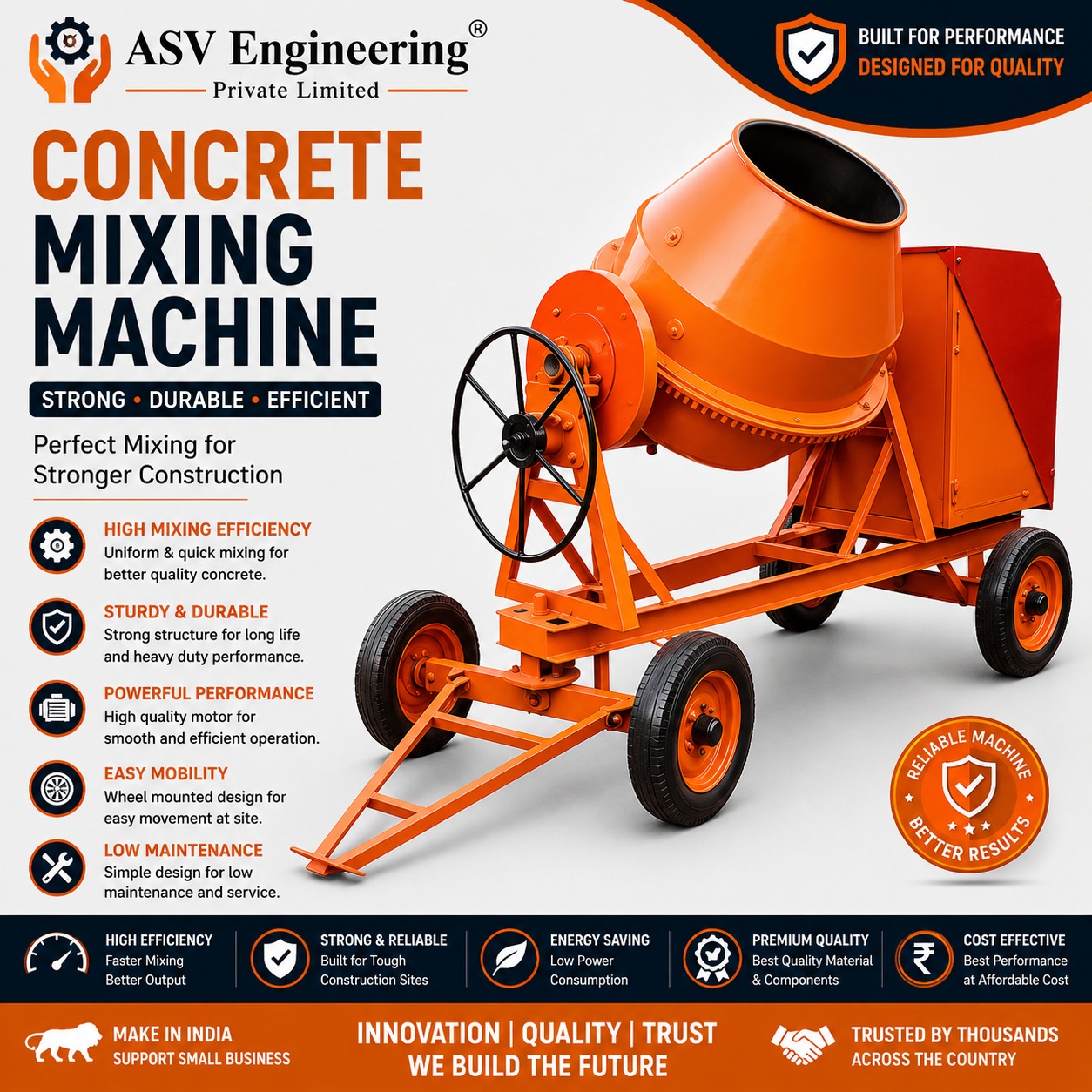
Concrete Mixing Machine
View Details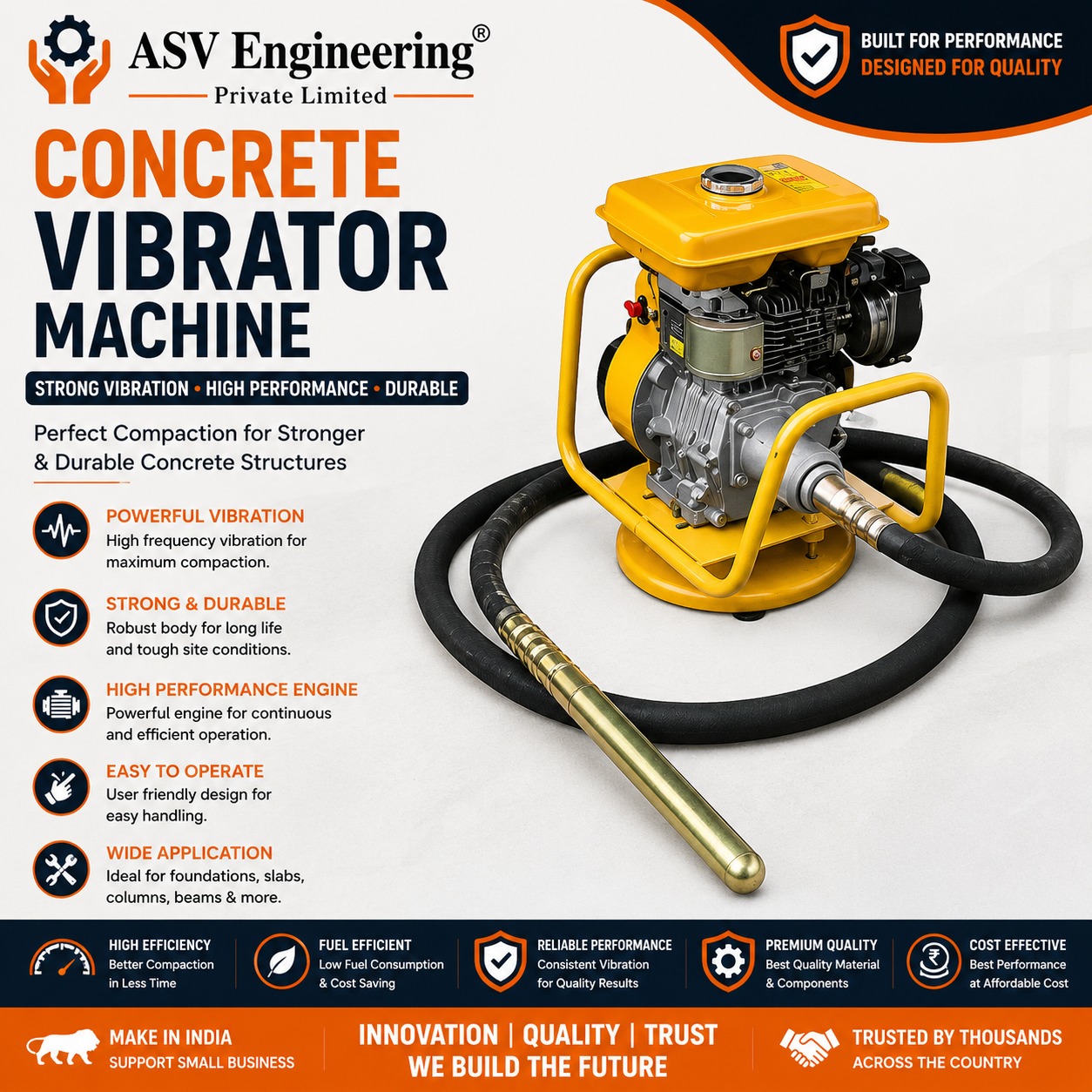
Concrete Vibrator Machine
View Details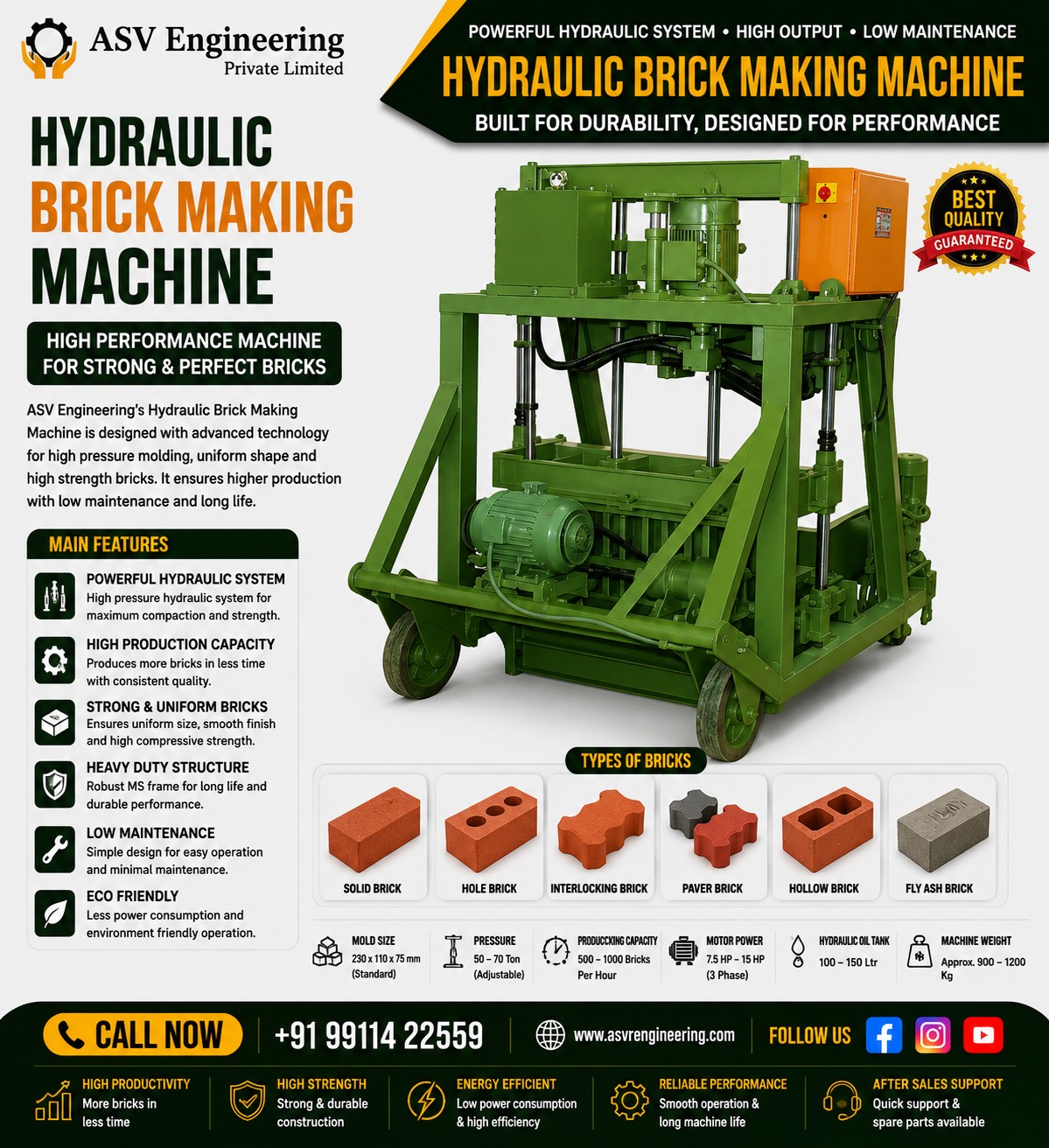
Hydraulic Brick Making Machine
View Details