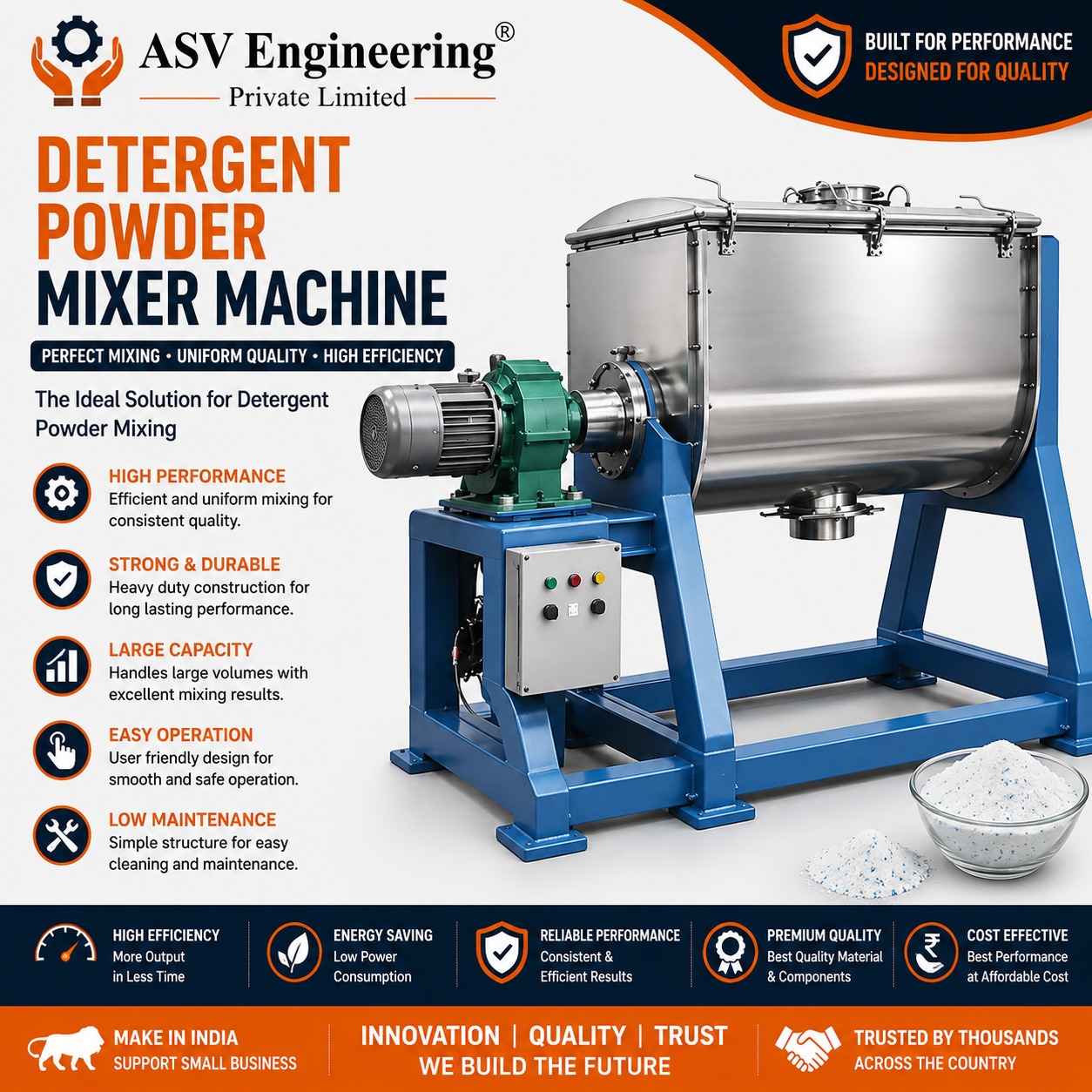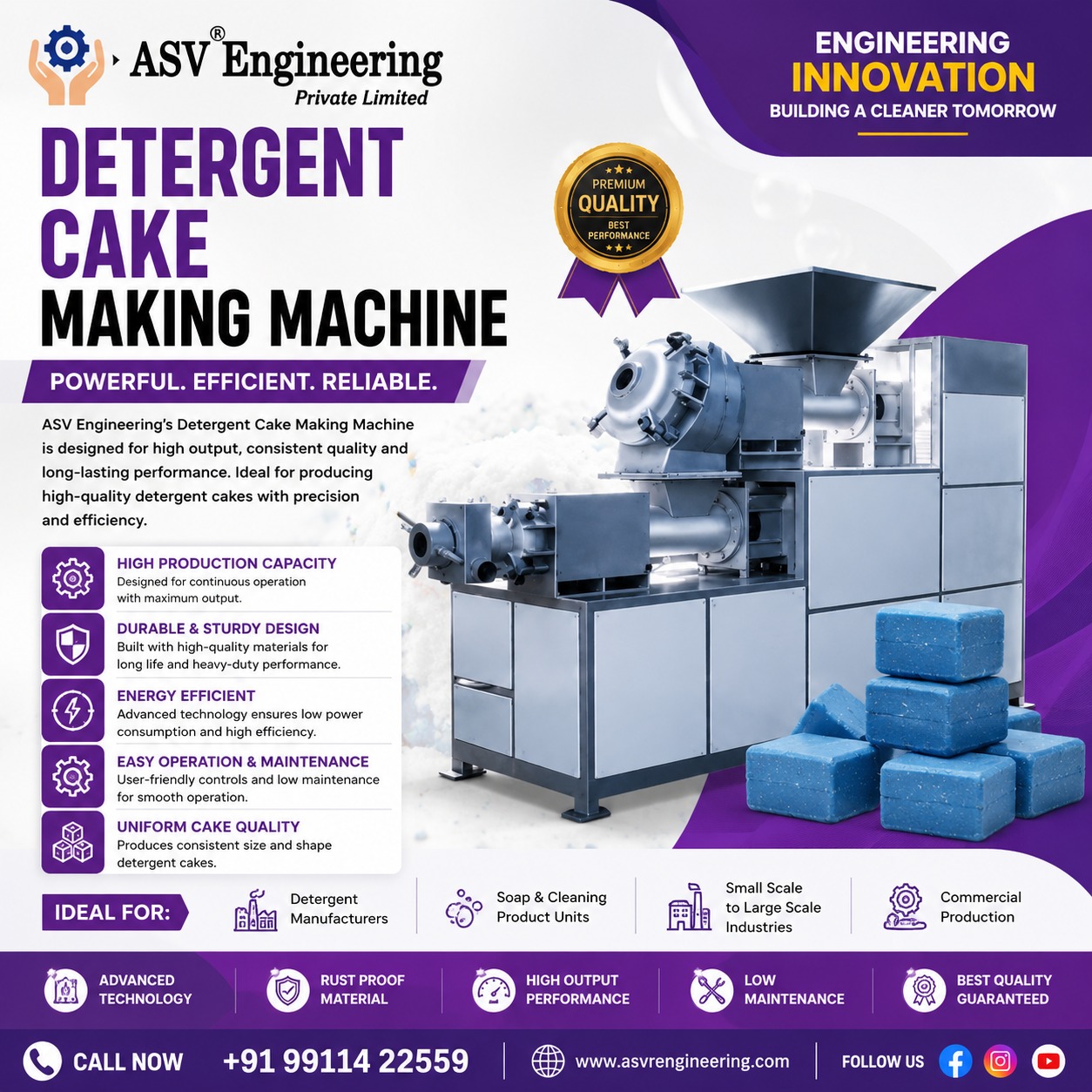
Detergent Cake Making Machine
Description
Looking for a detergent cake making machine manufacturer and supplier in Delhi, India? Our detergent cake making machine is a complete production system for manufacturing solid detergent bars, soap cakes, and washing bars that are popular across Indian households, particularly in rural and semi-urban markets where detergent cakes remain the preferred format for hand-washing clothes. The detergent cake segment represents a significant portion of the Indian FMCG market, and owning your own production line gives you the ability to manufacture these high-demand products under your own brand, compete effectively on price, and build a loyal customer base in your target region. Our machine handles the full production process from mixing and plodding to cutting, stamping, and wrapping-ready output. Every unit is manufactured at our Nangloi, Delhi factory with durable components and practical design for consistent daily production.
What is a detergent cake making machine? A detergent cake making machine is an integrated production line that converts detergent cake base material, which is a mixture of surfactants, fillers, binders, and additives, into uniformly shaped and sized solid detergent bars. The process involves mixing the ingredients into a homogeneous paste, extruding the paste through a plodder into a continuous bar, cutting the bar into individual cake lengths, and stamping or pressing each piece into its final shape. The finished cakes are then ready for wrapping and sale. This machine replaces manual or semi-manual methods of pressing detergent powder into cakes, which are slow, inconsistent in weight and shape, and not suitable for commercial-scale production.
Key Features and Build Quality. The mixing stage uses a sigma blade mixer or a ribbon blender, depending on the formulation, that thoroughly blends the wet and dry ingredients into a smooth, pliable paste. The mixer bowl and blades are made from AISI 304 stainless steel for hygiene and easy cleaning. The mixed paste is then fed into a plodder, which is a twin-screw extruder designed specifically for soap and detergent processing. The plodder compresses the paste and forces it through a die plate that shapes it into a continuous rectangular or oval cross-section bar. The die plate can be changed to produce different cake shapes and sizes, from small travel-size bars to large economy packs. After extrusion, the continuous bar passes along a conveyor belt to the cutting station where a rotating blade or a guillotine cutter slices it into individual cakes of precise length. The cut cakes then move to the stamping station where a hydraulic or mechanical press stamps the brand name, logo, or decorative pattern onto the surface of each cake and simultaneously adjusts the final dimensions and weight. The stamping station uses interchangeable die sets, so you can produce different product variants or limited editions simply by swapping the die.
How does the detergent cake making machine work? The process starts with the operator loading the detergent cake base ingredients into the mixer. For a standard detergent cake, this typically includes a mix of detergent active matter such as linear alkyl benzene sulphonate or sodium lauryl ether sulphate, fillers like talc or calcium carbonate, binding agents such as sodium silicate or starch, and small quantities of fragrance, colour, and opacifier. The mixer blends these for 15 to 20 minutes until a smooth, lump-free paste is formed. The paste is then transferred to the plodder hopper. The twin screws in the plodder grip the paste and push it forward under pressure through the die plate, extruding a continuous bar. The bar travels along a food-grade conveyor belt to the cutter, which slices it into individual pieces at a consistent length. Each piece then passes under the stamping press where it receives its branded impression and final dimensional adjustment. The stamped cakes continue along the conveyor to a collection table or directly to a wrapping machine if one is integrated into the line. The entire process is semi-automatic, requiring one operator to load the mixer, monitor the line, and collect finished cakes, though a fully automatic line with upstream mixing and downstream wrapping can also be configured.
Technical Specifications. Our standard detergent cake making machine has a production capacity of 1000 to 2000 cakes per hour, depending on the cake size and weight. A typical detergent cake weighs between 75 grams and 200 grams, and the machine can be adjusted to produce any weight within this range. The sigma mixer has a working volume of 200 litres and is driven by a 5 HP motor. The plodder has a screw diameter of 100 mm and is driven by a 7.5 HP motor with a variable speed drive for controlling the extrusion rate. The cutting station uses a precision rotary cutter that can handle continuous bar speeds up to 20 metres per minute. The stamping press is rated at 5 tonnes and operates at a cycle rate matching the line speed. The conveyor belt is 300 mm wide and 4 metres long, made from food-grade PVC or PU material. The total connected power is approximately 20 kW at 415V three-phase, 50 Hz. The system footprint is approximately 6000 mm by 1500 mm by 1800 mm in height. A compact model with a 500 to 800 cake per hour capacity is available for smaller operations.
Applications and Industries. This machine is used by detergent manufacturers who produce washing soap bars for the domestic market, by private label producers who make detergent cakes for FMCG brands, by institutional suppliers who produce cleaning bars for hotels, hostels, and laundry services, by export manufacturers who supply detergent bars to markets in Africa, Southeast Asia, and the Middle East where solid detergent format is popular, and by soap manufacturers who produce both bathing soap and detergent bars on the same production line by changing the formulation and die sets.
Benefits of Choosing Our Detergent Cake Making Machine. The consistent weight and dimensions that the machine produces are essential for retail packaging, where each cake must match the weight printed on the wrapper and fit into the packaging material without manual adjustment. The branding and decorative stamping give your product a professional, market-ready appearance that competes with established brands on the shelf. The semi-automatic operation requires minimal labour while still being affordable compared to fully automatic lines that are economically viable only at very high production volumes. The interchangeable die sets give you the flexibility to produce different cake sizes and shapes on the same machine, which is valuable if you serve multiple market segments. The durable construction ensures that the machine runs reliably for years with routine maintenance, and the straightforward mechanical design means that repairs and part replacements are uncomplicated.
Maintenance and Care. Clean the mixer, plodder screws, and die plate after every production run to prevent dried paste buildup that could affect the quality of the next batch. The plodder screws should be inspected every 200 hours for wear, particularly in the compression zone where the highest forces occur, and replaced when the extrusion quality begins to degrade. Lubricate the plodder bearings and the stamping press mechanism every 100 hours with a food-safe lubricant. Check the conveyor belt tension and alignment weekly and adjust or replace the belt as needed. Inspect the cutting blade for sharpness regularly and sharpen or replace it to maintain clean, square cuts on each cake. The stamping dies should be cleaned after each use to prevent colour transfer between different product variants and stored in a dry location to prevent corrosion. Check all safety guards and interlocks monthly to ensure they are functioning properly.
Frequently Asked Questions. What is the price of a detergent cake making machine? Our pricing depends on the production capacity, level of automation, and any customisation of dies or mixing systems. Contact us for a detailed quotation. How many cakes can it produce per hour? Our standard line produces 1000 to 2000 cakes per hour, and a compact model is available at 500 to 800 cakes per hour. What cake sizes can it make? The machine can produce cakes from 75 grams to 200 grams, and custom die sizes are available for special requirements. Do you supply the stamping dies? Yes, we manufacture custom stamping dies with your brand name, logo, or any design you specify. What raw materials do I need? The primary ingredients are detergent surfactant paste, fillers such as talc or calcium carbonate, binding agents, fragrance, and colour. We can guide you on formulations and supplier contacts.
Why Choose Our Delhi Factory and How to Order. We design and build the detergent cake making machine at our Nangloi, Delhi factory, and we take a hands-on approach with every customer to ensure the machine is configured correctly for their specific product requirements. From formulation advice to die design to production line layout, our team supports you beyond just the equipment sale. We provide pan-India delivery, installation, commissioning, and operator training at your facility. To discuss your detergent cake production needs, call us at +91 8588856870. We invite you to visit our Nangloi factory to see the machine in operation, examine the cake quality it produces, and discuss your brand requirements with our engineering team in person.
| Specification | Details |
|---|---|
| Machine Type | Detergent Cake Making Machine |
| Body Material | SS304 / MS |
| Power Supply | 220V/440V Three Phase |
| Warranty | 1 Year |
Related Products
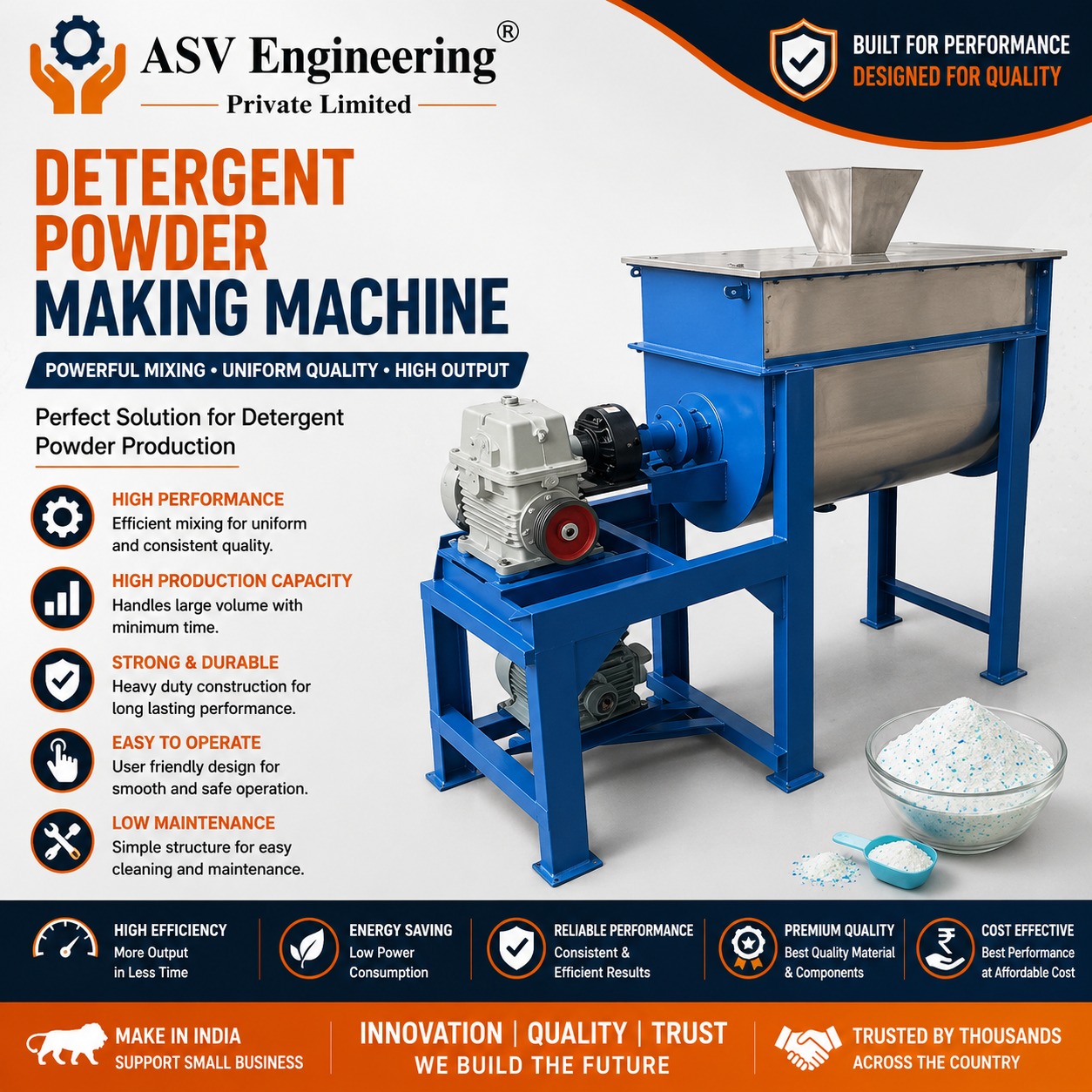
Detergent Powder Making Machine
View Details